If you have questions about this program, email the
program leader listed below.
Building and Breathing Madrid: Capital of a Global Empire
Program Details
The arrangements for the travel, housing, meals, excursions and course content of
this program have been made by the leader. Questions about this program can only be
answered by the program leader listed below.
|
| Program Type |
Departmental |
| Program Location |
Madrid, Spain
|
| Course # |
SA 11003
|
| Duration |
Summer
|
| Upcoming Program Dates |
| Summer 2027 |
05/16/27 to 05/30/27
|
Please Note: Programs may be altered or adapted with little notice
Program Description
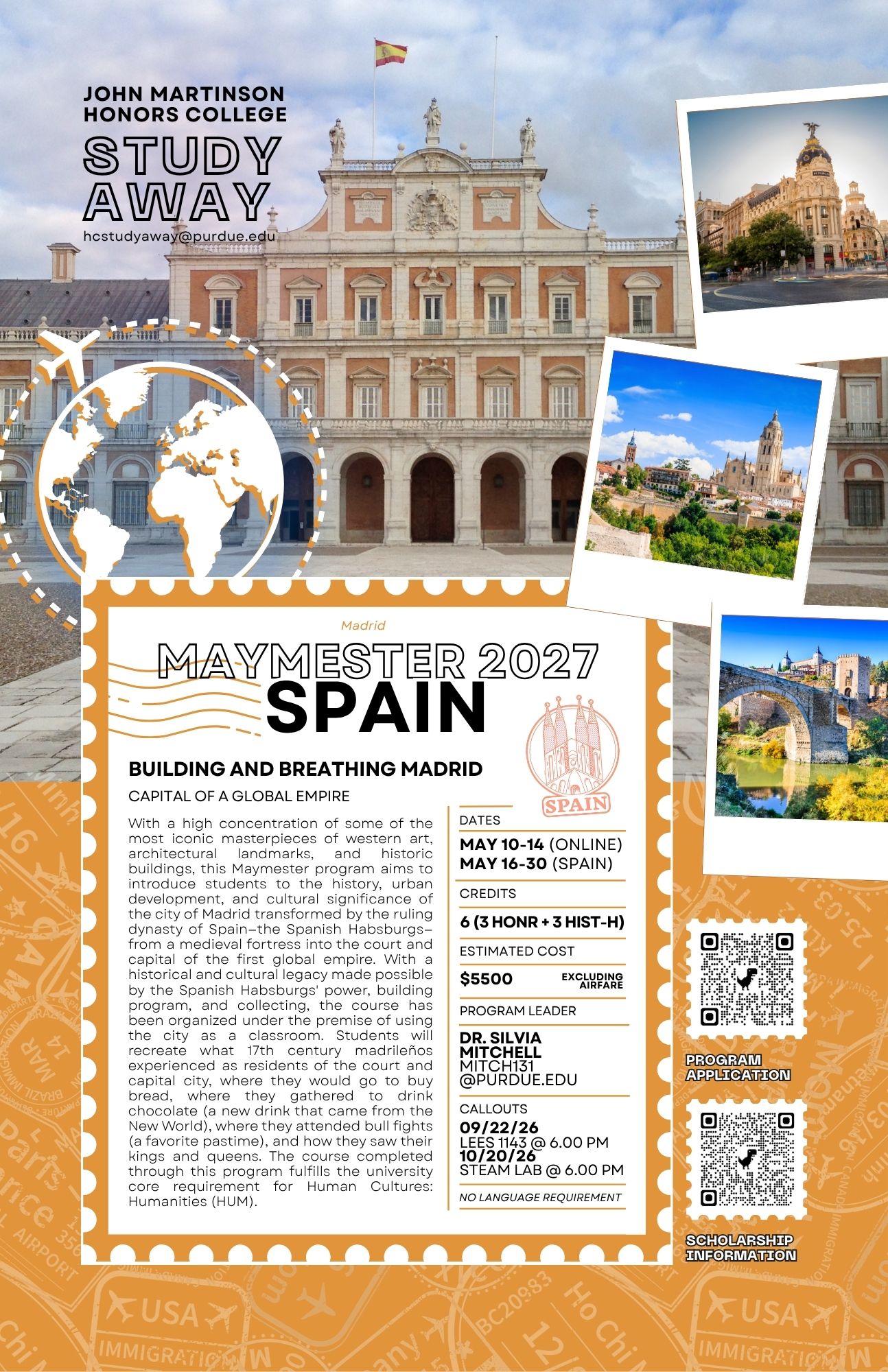
Taking place entirely in Madrid, this Study-Abroad Honor program focuses on the city’s historical, artistic, and architectural development under the Habsburgs, the dynasty that ruled the Spanish monarchy as a global empire. While delivery of the curriculum is fully integrated, students will register for two, 3-credit Honor Courses: “HONR 315—Madrid: Court and Capital of Spain’s Global Empire” and “HIST 302H—The Spanish Habsburgs, 1500-1700.” Our journey begins with an exploration of Madrid’s medieval Arabic foundations and follows with understanding its development into a fully Renaissance city when the Habsburgs adopted it as their permanent residence in the sixteenth century. Then, we will delve into the Madrid that became the paragon of baroque culture in the seventeenth century and experience it through the eyes of the rulers and inhabitants of the past. We will walk through the same areas in a city famous for extreme fashion styles, popular festivities, and aristocratic carriage-drawn outings in the parks, and recreate some of the most common activities that Madrid residents—madrileños—adopted, such as consuming new and fun foods like chocolate in the Plaza Mayor. All of these activities took place in today’s paradigmatic tourist destinations and have been immortalized in the magisterial art left behind by the likes of Rembrandt, Titian, and Velazquez. Visits to the Royal Palace, the Plaza Mayor, the Plaza del Oriente, the Retiro Park, and the Casa del Campo as well as finding art in the most important museums, such as the Prado, but also in less visited churches and buildings sprinkled in the old areas of the city, will be the lens through which we will appreciate the artistic, cultural, and power structures that helped make Madrid one of the most cosmopolitan cities of the time. The course includes day trips to nearby cities—Segovia, Toledo, El Escorial, and Aranjuez—to provide additional perspectives and points of comparison. Adopting Madrid as a classroom, this course provides a unique experience of the Habsburgs’ splendid artistic, cultural, and historical legacy.
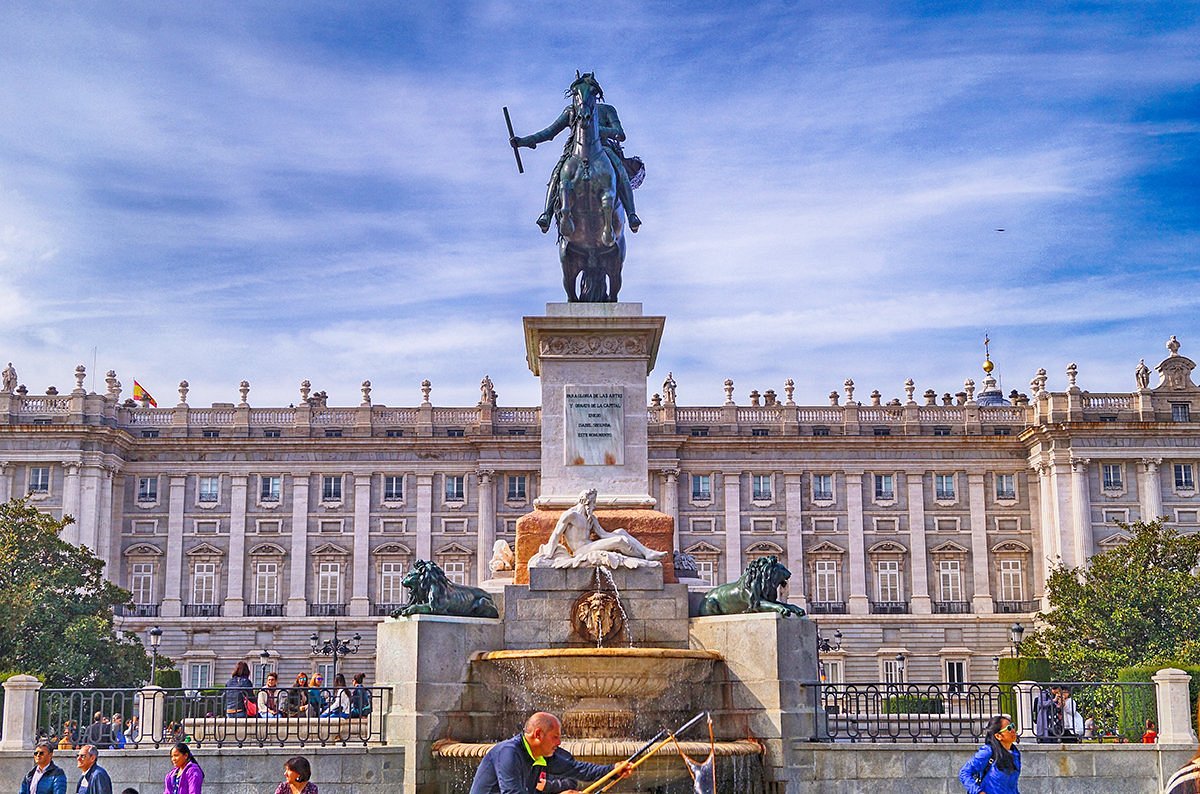
The impressive bronze equestrian monument in the Plaza del Oriente was cast by the Italian sculptor, Pietro Tacca; it represents King Philip IV (r. 1621-1665). Located in a favorite tourist destination, very few people know how the statue ended up there and how significant its relocation was.
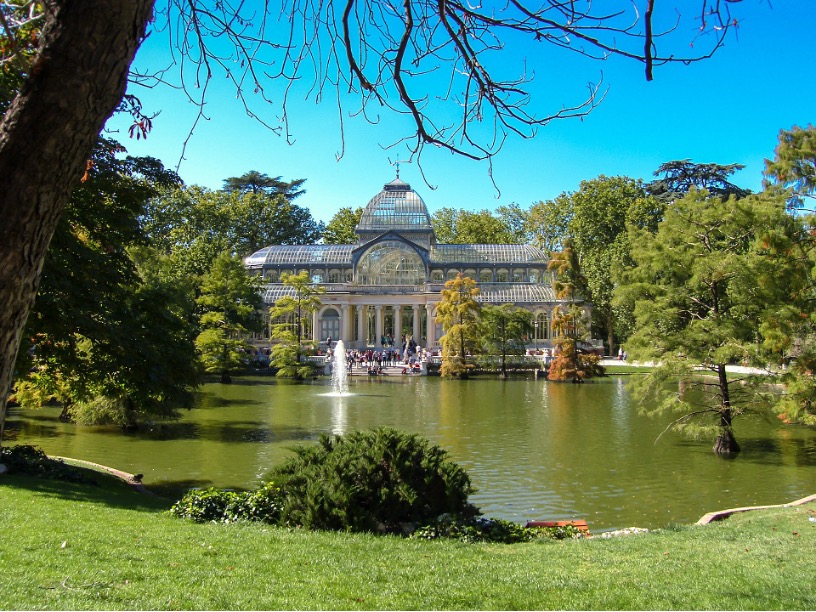
An example of a "classroom" in the city: The Retiro Park, one of the most popular destinations for anyone visiting Madrid was initially built by Philip IV as a pleasure palace; although the initial building did not survive, the gardens continue to provide an illydic setting for an afternoon stroll, sightseeing, and a host of fun outdoor activities. For us, it will also be an opportunity to think about how inhabitants of the city experienced it.
Please contact program leader for more information: Silvia Z. Mitchell, mitch131@purdue.edu
Professor Mitchell is a leading expert of the history of the Spanish monarchy in the seventeenth century and the royal House of Habsburgs. For more information about her research and publications, clicke here: Silvia Z. Mitchell
Academic Credit
While delivery of the curriculum is fully integrated, students will earn credit for two, 3-credit Honor Courses:
HONR 315—Madrid: Court and Capital of Spain’s Global Empire
HIST 302H—The Spanish Habsburgs, 1500-1700
Eligibility
There are no language requirements for this program. Students must be part of the HONORS College or have at least a 3.0 GPA to be admitted to the program.
Program Cost
Students pursuing program participation accept financial responsibility. Purdue will take measures to mitigate financial risks, although will not be liable for loss.
estimated $5,500 (excludes airfare)
Espasahotel Plaza de España—Central location in the city, walking distance to all places we will be visiting.
Free internet.
Double rooms with Kitchenette and small fridge.
Free continental breakfast.
- Transportation from airport to hotel on arrival (departure on public transport or share taxis).
- Entrance fee to four major museums in Madrid:
Museo del Prado
Palacio Real
Museo Reina Sophia
Museo Thyssen
- Transportation to and from, dinner, and entrance fee to landmarks to the following cities:
El Escorial
Segovia
Toledo
Aranjuez
Giant Leaps Scholarship
Participants who are US citizens or permanent residents are strongly encouraged to apply for the Giant Leaps Scholarship through the MyStudyAbroad system. Giant Leaps awards are based on total family income and require having a FAFSA on file. For this Maymester program, participants are eligible for the following amounts of scholarship funding, which can be applied to the program fee billed by Purdue but also expenses like airfare.
- Total family income of $75,000 or less: $1500 applied to the program cost
- Total family income of $75,001 to $100,000: $1000 applied to the program cost
- Total family income of $100,001 to $125,000: $800 applied to the program cost
- Total family income of $125,001 to $150,000: $400 applied to the program cost
- Total family income of $150,001 or greater: Ineligible
For complete details on eligibility, application procedures, and deadlines, please visit https://www.purdue.edu/gpp/sa/financialresources/sa-office-based/giant_leaps_summer.html.
JMHC Global Enrichment Grants
Members of the John Martinson Honors College are encouraged to apply for a Study Away Global Enrichment Grant to support their participation in this program. Information about these grants, including eligibility, deadlines, and the application link, can be found at https://honors.purdue.edu/scholarship/experiential-learning.php. Students participating in this Maymester program can apply in either the October 15th or February 1st application cycle.
Please do NOT make any financial commitments toward the program (such as purchasing airfare) until instructed by the program leader.
Application Deadline
Priority Deadline is December 1st, 2026. After that, applications will be accepted and reviewed on a rolling basis.
Financial Aid
Purdue University financial aid may be applied to the costs of studying abroad. Students interested in receiving financial aid should
NOTE: Recipients of certain tuition remission and scholarship programs should pay careful attention to the regulations for using those benefits for study abroad. Ask your financial aid advisor about any limitations.
Click here for a list of scholarships and grants available to assist with the costs of studying overseas.
